Will antisemitism decrease now that there’s a ceasefire?
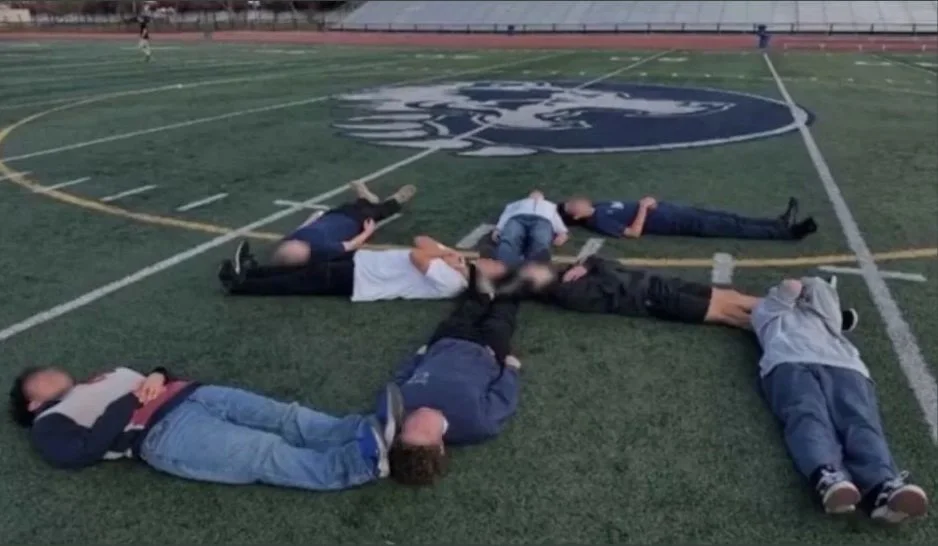
Students from Branham High School shared the image above, created with their own bodies, alongside a disturbing social media post quoting Adolf Hitler. December 2025 in San Jose. Read more.
*Note that this article is part of a new series. Stay tuned!
One question I’ve been hearing a lot lately is whether antisemitism will decrease now that we have a ceasefire in the war between Israel and Hamas.
After previous wars and flare-ups of violence between Israelis and Palestinians, the spikes in antisemitism that accompanied them eventually subsided. So, if the past is any guide, we might expect some relief.
But it’s not that simple.
Antisemitism was already at historic highs on October 6, 2023. The rise began years earlier when white-nationalist rhetoric, which is inextricably connected to antisemitism, re-entered the public sphere, and several high-profile antisemitic incidents followed.
The environment worsened over time and, according to the ADL audit at the time, 2022 represented the “the highest number on record since ADL began tracking antisemitic incidents in 1979.” In the years following the October 7, 2023, Hamas attack on Israel, every measurement of antisemitism skyrocketed.
Inflammatory and hostile rhetoric has become normalized in our country, as has increased polarization. Antisemitic rhetoric has embedded itself in conversations about the war in Gaza and about Jews globally and here at home. Once the current conflict abates, those attitudes won’t simply vanish, even if they become less visible.
Nor is antisemitism confined to one side of the political aisle: Today’s hateful rhetoric about Jews and Israel is coming from the far left as well as the far right. The hate speech from the far left closely resembles that from the far right, reflecting what’s often called the “horseshoe theory” of antisemitism: The political spectrum isn’t a straight line – at the extreme ends, it bends into a horseshoe shape, where both extremes start to look and sound alarmingly similar.
Antisemitic attitudes run deep in our society. Much of it is unconscious, but surfaces in moments of crisis. Over the last couple of years, surveys have shown that Americans are increasingly believing classic anti-Jewish tropes and stereotypes.
Complicating matters further, recent research suggests that Americans, even if they don’t buy into the tropes themselves, are becoming dismissive about the rise in antisemitism, with a near majority thinking that Jews can deal with the problems themselves.
Even if the ceasefire holds, we don’t expect any of these factors to disappear overnight. We have a long road ahead of us to truly address the problem.
I’ll be diving deeper into some of these ideas in upcoming posts. Follow me on LinkedIn for updates.